
2-Propynyl 2-pyranyl ether
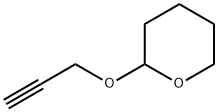
- CAS number
- 6089-04-9
- Molecular formula
- C8H12O2
- Molecular weight
- 140.18 g/mol
- Standard packing
- 1kg / 25kg / 100kg
Catalogued as CAS 6089-04-9, 2-Propynyl 2-pyranyl ether is a C8H12O2 alkyne carried in kilogram quantities.
The terminal C-H is the reactive end: it is metalated and trapped, coupled under Sonogashira conditions, or cycloadded with an azide in a copper-catalysed reaction. The ring constrains the geometry of the fragment, so the entry is bought for the shape it imposes on the rest of the molecule rather than for a single reactive site. The protecting group is the reason the entry exists: it is carried through the steps that would otherwise attack the group underneath, and removed when that group is wanted.
The formula C8H12O2 resolves to 8 carbons with 2 oxygens. At 8 carbons the entry is an oil or a low-melting solid, and it is handled at ambient temperature in most steps.
Where this entry sits in a route
2-Propynyl 2-pyranyl ether is propargyl alcohol with the hydroxyl masked as a tetrahydropyranyl ether. The THP group survives Grignard reagents, hydride reductions and most cross-couplings, and is removed under mild acid, which is exactly the profile needed when a hydroxyl has to be carried through three or four steps without protection and deprotection of its own.
What the analysis covers
The lot is checked for free propargyl alcohol, which is the hydrolysis product, and for the diastereomeric ratio of the THP acetal. The acetal carbon is a new stereocentre, so the entry is a mixture of two diastereomers by definition.
Handling and storage
The container is kept sealed and out of light. Alkynes are checked for the coupled diyne before use, because that is the impurity that builds on standing.
Ordering
Packing 1kg / 25kg / 100kg, with the batch COA, the SDS and a specification sheet suitable for incoming inspection travelling with the lot.
Quotation questions for this entry
Is the THP group removed under acidic conditions?
Yes. Mild aqueous acid cleaves it, and the by-product is a volatile lactol that is removed on work-up. Strong acid is avoided because the alkyne is acid sensitive.
Does the THP acetal create a new stereocentre?
It does, and the entry is therefore a mixture of two diastereomers. That is normal for THP ethers and does not usually affect the downstream step.
Why use the protected form instead of propargyl alcohol?
Because the free hydroxyl reacts in most of the steps where the alkyne is being used. The THP group removes that competition.
What is the usual quantity?
Kilogram lots are standard; the entry is also quoted at 25 kg and 100 kg.
Other protected & silylated alkynes entries
| CAS | Compound | Formula | MW | Packing | Quote |
|---|---|---|---|---|---|
| 18180-30-8 | 2-((prop-2-yn-1-yloxy)Methyl)oxirane | C6H8O2 | 112.13 | 1kg / 25kg / 100kg | Request |
| 1066-54-2 | Trimethylsilylacetylene | C5H10Si | 98.22 | 1kg / 25kg / 100kg | Request |
Ask about 2-Propynyl 2-pyranyl ether
The form below is pre-filled with this entry. Add the quantity, the specification you need to meet and the destination, and a written quotation follows within one business day.
| Entry | 2-Propynyl 2-pyranyl ether |
|---|---|
| CAS | 6089-04-9 |
| Typical lead time | Stock or 2–4 weeks |
| Documentation | COA, SDS, spec sheet |
Request a quotation
2-Propynyl 2-pyranyl ether (6089-04-9)