
Methyl 1,2,3-Triazole-4-carboxylate
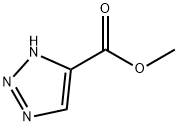
- CAS number
- 4967-77-5
- Molecular formula
- C4H5N3O2
- Molecular weight
- 127.10 g/mol
- Standard packing
- 1kg / 25kg / 100kg
Methyl 1,2,3-Triazole-4-carboxylate is catalogued as a heterocyclic entry: CAS 4967-77-5, formula C4H5N3O2, 127.10 g/mol.
Ring functionalisation is usually the selectivity problem here: the position that reacts first is set by the heteroatom and by whatever is already on the ring.
The formula C4H5N3O2 resolves to 4 carbons with 2 oxygens and 3 nitrogens. With 4 carbons the molecule is small enough to be lost to evaporation during a work-up, so the step is usually run closed.
Where this entry sits in a route
Methyl 1,2,3-triazole-4-carboxylate is the product side of a copper-catalysed azide-alkyne cycloaddition, and also a starting point in its own right: the ester is the handle for amidation or hydrolysis, and the triazole ring is a stable, planar amide bioisostere. It is bought both by groups building triazole libraries and by groups that need a pre-formed ring.
What the analysis covers
The lot is checked for the regioisomeric triazole, which is the main impurity from a non-selective cycloaddition, and for residual copper. Copper is the number that matters if the entry is going into a biological assay.
Handling and storage
Store closed, dry and dark. Ring oxidation and discolouration are the usual signs that a lot has been open too long.
Ordering
Quoted from stock in 1kg / 25kg / 100kg, or made to order where the lot has run down. Either way the same release testing applies. Where a specification has to be met on paper before shipment, it is agreed in writing and the lot is qualified against it rather than against the catalogue text.
Quotation questions for this entry
Is it the 1,4- or the 1,5-regioisomer?
The catalogue entry is the 1,4-disubstituted triazole, which is the product of a copper-catalysed cycloaddition. The 1,5-isomer can be quoted separately.
Is residual copper controlled?
Yes. Copper content is measured and stated, because it matters for any downstream biological work.
Can the ester be converted to an amide?
Yes, and that is the most common next step. The methyl ester is small enough that aminolysis proceeds without steric problems.
What packing is standard?
1 kg, 25 kg and 100 kg; gram samples are available for library work.
Other heterocycles entries
| CAS | Compound | Formula | MW | Packing | Quote |
|---|---|---|---|---|---|
| 32477-35-3 | 1-(Heptafluorobutyryl)imidazole | C7H3F7N2O | 264.10 | 1kg / 25kg / 100kg | Request |
| 23616-31-1 | 1,6-Naphthyridin-5(6H)-one | C8H6N2O | 146.15 | 1kg / 25kg / 100kg | Request |
| 872701-04-7 | 1H-1,2,3-Triazole-4-butanoic acid | C6H9N3O2 | 155.15 | 1kg / 25kg / 100kg | Request |
| 16681-70-2 | 1H-1,2,3-Triazole-5-carboxylic acid | C3H3N3O2 | 113.08 | 1kg / 25kg / 100kg | Request |
| 521300-19-6 | 1H-Pyrazole-3-carboxylic acid, 5-cyclopentyl-, ethyl ester | C11H16N2O2 | 208.26 | 1kg / 25kg / 100kg | Request |
| 19668-85-0 | 2-(3-Methyl-1,2-oxazol-5-yl)acetic acid | C6H7NO3 | 141.12 | 1kg / 25kg / 100kg | Request |
| 218784-65-7 | 2-(3-Methylisoxazol-5-yl)ethanol | C6H9NO2 | 127.14 | 1kg / 25kg / 100kg | Request |
| 114905-18-9 | 2-(5-Chloropentyl)-1,3-dioxolane | C8H15ClO2 | 178.65 | 1kg / 25kg / 100kg | Request |
Ask about Methyl 1,2,3-Triazole-4-carboxylate
The form below is pre-filled with this entry. Add the quantity, the specification you need to meet and the destination, and a written quotation follows within one business day.
| Entry | Methyl 1,2,3-Triazole-4-carboxylate |
|---|---|
| CAS | 4967-77-5 |
| Typical lead time | Stock or 2–4 weeks |
| Documentation | COA, SDS, spec sheet |
Request a quotation
Methyl 1,2,3-Triazole-4-carboxylate (4967-77-5)