
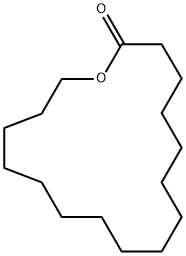
16-Hexadecanolide
- CAS number
- 109-29-5
- Molecular formula
- C16H30O2
- Molecular weight
- 254.41 g/mol
- Standard packing
- 1kg / 25kg / 100kg
CAS 109-29-5, 16-Hexadecanolide, is a lactone building block (C16H30O2) whose ring is opened or carried through as the route requires.
Macrocyclic lactones of this size are closed in dilute solution, so residual solvent and the grade of the lot matter as much as the assay.
The formula C16H30O2 resolves to 16 carbons with 2 oxygens. With 16 carbons the lipophilicity dominates: solubility in polar media falls away and the work-up is usually a phase separation.
Where this entry sits in a route
16-Hexadecanolide is a macrocyclic lactone, the ring-closed form of 16-hydroxyhexadecanoic acid. It is bought as a fragrance material and as a monomer for ring-opening polymerisation, and both uses depend on the same property: the ring is strained enough to open cleanly but stable enough to store.
What the analysis covers
The lot is checked for the open-chain hydroxy acid and for residual catalyst from the cyclisation. The hydroxy acid is the impurity that matters, because it changes both the odour profile and the polymerisation behaviour.
Handling and storage
Store closed and dry, and check the residual hydroxy acid if the container has been open for a while.
Ordering
Packing 1kg / 25kg / 100kg, with the batch COA, the SDS and a specification sheet suitable for incoming inspection travelling with the lot.
Quotation questions for this entry
What is the difference between the lactone and the hydroxy acid?
They are the closed and open forms of the same molecule. The lactone is the storage form; the hydroxy acid is what appears when the ring is opened by base or by moisture.
Is it used as a fragrance material?
Yes, and as a monomer. Both uses are supported by the same specification, which is why the residual hydroxy acid is controlled.
How is it packed?
1 kg, 25 kg and 100 kg. The material is warmed before packing so that the unit weight is accurate.
Can it be polymerised directly?
Ring-opening polymerisation is the usual route, with a metal or organocatalyst. The water content of the lot has to be controlled because it acts as a chain transfer agent.
Other acids, esters & lactones entries
| CAS | Compound | Formula | MW | Packing | Quote |
|---|---|---|---|---|---|
| 42516-28-9 | (E)-Ethyl 4-(diethoxyphosphoryl)but-2-enoate | C10H19O5P | 250.23 | 1kg / 25kg / 100kg | Request |
| 14113-05-4 | 10-Hydroxy-2-decenoic acid | C10H18O3 | 186.25 | 1kg / 25kg / 100kg | Request |
| 83905-98-0 | 11-Hydroxyundecylphosphonic acid | C11H25O4P | 252.29 | 1kg / 25kg / 100kg | Request |
| 506-13-8 | 16-Hydroxyhexadecanoic acid | C16H32O3 | 272.42 | 1kg / 25kg / 100kg | Request |
| 10154-71-9 | 3-(Phenylsulfonyl)propionic acid | C9H10O4S | 214.24 | 1kg / 25kg / 100kg | Request |
| 1577-22-6 | 5-Hexenoic acid | C6H10O2 | 114.14 | 1kg / 25kg / 100kg | Request |
| 59320-77-3 | 8-Methylnon-6-enoic acid | C10H18O2 | 170.25 | 1kg / 25kg / 100kg | Request |
| 28645-51-4 | Ambrettolide | C16H28O2 | 252.39 | 1kg / 25kg / 100kg | Request |
Ask about 16-Hexadecanolide
The form below is pre-filled with this entry. Add the quantity, the specification you need to meet and the destination, and a written quotation follows within one business day.
| Entry | 16-Hexadecanolide |
|---|---|
| CAS | 109-29-5 |
| Typical lead time | Stock or 2–4 weeks |
| Documentation | COA, SDS, spec sheet |
Request a quotation
16-Hexadecanolide (109-29-5)