
4-Chlorophenylboronic acid
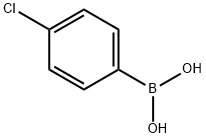
- CAS number
- 1679-18-1
- Molecular formula
- C6H6BClO2
- Molecular weight
- 156.38 g/mol
- Standard packing
- 1kg / 25kg / 100kg
4-Chlorophenylboronic acid is a boronic acid entry (CAS 1679-18-1, C6H6BClO2) supplied in kilogram lots.
Boronic acids are often the limiting reagent in a coupling, so the assay of the lot changes how much halide has to be charged.
The formula C6H6BClO2 resolves to 6 carbons with 2 oxygens, one boron and one chlorine. With 6 carbons the molecule is small enough to be lost to evaporation during a work-up, so the step is usually run closed.
Where this entry sits in a route
4-Chlorophenylboronic acid carries two handles that can be addressed in either order: the boronic acid for a Suzuki coupling, and the aryl chloride for a second coupling or for halogen-metal exchange. That makes it the usual way to install a para-substituted phenyl ring while keeping a functional handle for later.
What the analysis covers
The lot is checked for the boroxine that forms on dehydration and for residual brominated starting material. Both affect the effective stoichiometry of the coupling, and the assay is corrected for the boroxine content.
Handling and storage
Keep sealed and dry. The boroxine that forms on dehydration is accounted for in the assay rather than being treated as a loss.
Ordering
Quoted from stock in 1kg / 25kg / 100kg, or made to order where the lot has run down. Either way the same release testing applies. The certificate states identity, assay and the analytical method used; a tighter limit than the catalogue entry can be written into the lot specification.
Quotation questions for this entry
Can the chloride and the boronic acid be coupled selectively?
Yes. The boronic acid reacts first under Suzuki conditions; the aryl chloride is much slower and survives, which is what makes the entry useful as a bi-functional building block.
Is the boroxine content corrected for?
It is measured and stated, and the assay on the certificate reflects the monomer content so that the charge can be calculated directly.
What is the standard packing?
1 kg, 25 kg and 100 kg.
Which coupling conditions are typical?
A palladium catalyst with a phosphine ligand and a mild base in aqueous dioxane or THF is the usual starting point; the exact conditions depend on the halide partner.
Other boronic acids & coupling reagents entries
| CAS | Compound | Formula | MW | Packing | Quote |
|---|---|---|---|---|---|
| 72931-54-5 | (3,3-Diisopropoxypropyl)triphenylphosphonium bromide | C27H34BrO2P | 501.4 | 1kg / 25kg / 100kg | Request |
| 223576-64-5 | (5-Chlorobenzofuran-2-yl)boronic acid | C8H6BClO3 | 196.40 | 1kg / 25kg / 100kg | Request |
| 6229-00-1 | (Triphenylsilyl)acetylene | C20H16Si | 284.4 | 1kg / 25kg / 100kg | Request |
| 21692-54-6 | 1-[2-(Triethylsilyl)ethynyl]cyclohexene | C14H24Si | 220.42 | 1kg / 25kg / 100kg | Request |
| 5272-36-6 | 3-(Trimethylsilyl)propargyl alcohol | C6H12OSi | 128.24 | 1kg / 25kg / 100kg | Request |
| 886593-45-9 | 4-(2-hydroxypropan-2-yl)phenylboronic acid | C9H13BO3 | 180.01 | 1kg / 25kg / 100kg | Request |
| 5930-98-3 | 4-(Trimethylsilyl)-3-butyn-2-one | C7H12OSi | 140.25 | 1kg / 25kg / 100kg | Request |
| 1560-54-9 | Allyltriphenylphosphonium bromide | C21H20BrP | 383.3 | 1kg / 25kg / 100kg | Request |
Ask about 4-Chlorophenylboronic acid
The form below is pre-filled with this entry. Add the quantity, the specification you need to meet and the destination, and a written quotation follows within one business day.
| Entry | 4-Chlorophenylboronic acid |
|---|---|
| CAS | 1679-18-1 |
| Typical lead time | Stock or 2–4 weeks |
| Documentation | COA, SDS, spec sheet |
Request a quotation
4-Chlorophenylboronic acid (1679-18-1)